October 6, 2026
When people argue about whether something is antisemitic — a protest chant, a classroom slide, a social-media post — one document comes up again and again: the IHRA Working Definition of Antisemitism . This explainer covers what it says, where it came from, how it is used in civil-rights law, and why it matters for Jewish students, parents and employees. What is the IHRA definition? The International Holocaust Remembrance Alliance (IHRA) is an intergovernmental body of dozens of member countries, including the United States. In 2016 its members adopted a "non-legally binding working definition" of antisemitism, building on an earlier working definition developed by a European monitoring agency in 2005. The core definition is short: "Antisemitism is a certain perception of Jews, which may be expressed as hatred toward Jews. Rhetorical and physical manifestations of antisemitism are directed toward Jewish or non-Jewish individuals and/or their property, toward Jewish community institutions and religious facilities." That sentence alone is general. What makes the definition useful in practice is the list of contemporary examples that comes with it. The examples, in plain language IHRA gives eleven examples of what could , depending on the overall context, be antisemitic. They include: Calling for, helping with, or justifying the killing or harming of Jews. Dehumanizing or stereotypical claims about Jews — for example, myths about Jews controlling the media, the economy or government. Blaming Jews as a people for wrongs committed by a single Jewish person or group. Denying the Holocaust or accusing Jews of inventing or exaggerating it. Accusing Jewish citizens of being more loyal to Israel than to their own country. Denying the Jewish people their right to self-determination — for example, by claiming that the existence of a State of Israel is a racist endeavor. Applying double standards by requiring of Israel behavior not expected or demanded of any other democratic nation. Using classic antisemitic symbols and images — such as the blood libel — to characterize Israel or Israelis. Comparing contemporary Israeli policy to that of the Nazis (see Holocaust inversion ). Holding Jews collectively responsible for the actions of the State of Israel. What the definition does not say The definition expressly states that criticism of Israel similar to that leveled against any other country cannot be regarded as antisemitic . It does not ban speech, and it is not a speech code. Its examples describe when hostility toward Israel crosses into hostility toward Jews — singling Israel out, denying Jews alone the right to a homeland, or recycling old antisemitic tropes in new political language. For more on that line, see our glossary entry on anti-Zionism vs. antisemitism . How it is used in civil-rights law On its own, the IHRA definition is not a law. Its legal weight comes from how government agencies and courts use it to recognize antisemitism under laws that already exist: Title VI of the Civil Rights Act of 1964 forbids discrimination based on race, color or national origin in federally funded programs, including public schools and most universities. The federal government treats discrimination against Jews based on shared ancestry or ethnic characteristics as covered. See Title VI . Executive Order 13899 (December 2019) directs federal agencies enforcing Title VI to consider the IHRA definition and its examples when deciding whether conduct was motivated by antisemitism. Many states, cities, universities and school districts have also adopted or referenced the definition in their own policies. In practice, this means that when a school receives complaints about antizionist harassment, the IHRA examples help show why the conduct targets Jewish students as Jews — and why the school may be legally required to respond. A school that ignores a hostile environment it knows about can be liable for deliberate indifference . Alternatives and criticism Some academics and advocacy groups have proposed alternatives, such as the 2021 Jerusalem Declaration on Antisemitism and the Nexus Document . Critics of IHRA argue its Israel-related examples could chill political speech. Supporters respond that the definition protects criticism of Israel by its own terms, and that the alternatives leave Jewish students without protection against the most common form of antisemitism they now face. JCAC's view is that antizionism aimed at Jews is today's most common form of antisemitism, and that the IHRA definition describes it accurately. The IHRA definition in JCAC's cases Several matters we follow involve exactly the conduct the IHRA examples describe: Brandeis Center v. State of California — Jewish families challenge antisemitic harassment and biased curriculum in California K-12 schools. StandWithUs v. MIT — Jewish students allege MIT tolerated a campus environment hostile to Jewish and Israeli students after October 7. Miller v. San Francisco Unified School District — a Jewish educator alleges hostility and retaliation after objecting to a union's "Palestine Solidarity" materials. Sumrall v. Ali — a woman alleges she was choked with the Israeli flag she was wearing. What you can do Learn the categories. Our legal guide for families breaks school antisemitism into fifteen types — see especially harassment of Jewish students , antisemitic speech, posters and clothing , and antisemitic or antizionist curriculum . Document what happens. Write it down, save screenshots and note witnesses. See Document everything . Ask what your school teaches. Use our free public records request tool to get curriculum materials. Report the incident to JCAC. This article is general information, not legal advice. Every situation depends on its facts — consult an attorney about your own case.
By JCAC
October 2, 2026
The Freedom of Access to Clinic Entrances Act — usually called the FACE Act — is best known for protecting reproductive health clinics. Fewer people know that the same federal law protects synagogues, churches, mosques, and every other place of religious worship . For Jewish communities facing protests that spill onto the steps of a shul, it is a federal civil-rights law worth knowing. What the FACE Act prohibits Enacted in 1994 and codified at 18 U.S.C. § 248, the Act makes it unlawful to: use force, the threat of force, or physical obstruction to intentionally injure, intimidate, or interfere with someone — or try to — because they are exercising, or seeking to exercise, their First Amendment right of religious freedom at a place of religious worship ; or intentionally damage or destroy the property of a place of religious worship. "Physical obstruction" means making entry to or exit from the house of worship impassable, or unreasonably difficult or hazardous. Peaceful protest and speech remain protected — the Act targets force, threats, blockades, and property damage, not viewpoints. Who can enforce it The FACE Act can be enforced three ways: Private lawsuits by people who were harmed, such as congregants blocked from attending services. Civil suits by the U.S. Attorney General or a state attorney general . Federal criminal prosecution , with fines and possible imprisonment that increase for repeat offenses and for conduct causing bodily injury. In a civil case, courts can order injunctive relief (for example, keeping protesters from blocking an entrance), compensatory and punitive damages, or statutory damages in place of actual damages, plus attorney's fees. The FACE Act and synagogue protests Since October 2023, Jewish congregations have seen demonstrations outside services and community events. When those protests cross the line into blocking doors, threatening worshippers, or violence, the FACE Act offers a federal remedy that does not depend on local police or prosecutors acting. A leading example is Helmann v. CodePink , a lawsuit arising from the June 2024 violence outside Adas Torah synagogue in Los Angeles. The case tests whether groups that organize and promote a protest online can be held responsible under the FACE Act for what happens at the house of worship. Read the case study for the court's rulings and the filings. If it happens at your synagogue Document everything : photos, video, the social-media posts that promoted the event, and names of witnesses. See our guide chapter on documenting incidents . Report it to local law enforcement and to the FBI or U.S. Attorney's office. Report the incident to JCAC so we can assess whether a FACE Act claim may be available. This article is general information, not legal advice. Every situation depends on its facts — consult an attorney about your own case.
By JCAC
October 2, 2026
Ethnic studies is now part of public education in California — and it is one of the most contested topics in California schools for Jewish families. This guide explains how ethnic studies came to California classrooms, what "liberated ethnic studies" means, and what parents can do to find out what their children are being taught. How ethnic studies came to California 2016 — AB 2016 directed the state to develop a model ethnic studies curriculum for high schools. 2019 — first draft withdrawn. The initial draft drew widespread criticism, including from Jewish organizations and lawmakers, for one-sided treatment of the Israeli-Palestinian conflict and for leaving out antisemitism. 2021 — model curriculum adopted. The State Board of Education approved a revised Ethnic Studies Model Curriculum that included lessons on antisemitism and the Jewish American experience. 2021 — AB 101 made a one-semester ethnic studies course a high school graduation requirement, phased in for later graduating classes and tied to state funding. Critically, the state model curriculum is optional . Districts may write their own courses or buy materials from outside groups — and that is where most of the controversy now lies. What is "liberated ethnic studies"? "Liberated ethnic studies" refers to an approach promoted by the Liberated Ethnic Studies Model Curriculum Consortium and allied activists, many of whom helped write the rejected 2019 draft. Its materials frame the subject through a lens of oppression and resistance and frequently present Zionism as a form of settler colonialism. Critics, including JCAC, argue that this content singles out Israel, erases Jewish identity and history, and creates a hostile environment for Jewish students. The fight is now in the courts. In September 2026, the Ninth Circuit revived a lawsuit brought by Jewish parents and teachers against the Consortium. Read our analysis: Ninth Circuit Win Revives the Fight Against Liberated Ethnic Studies . Your rights as a parent You can see the curriculum. California law gives parents the right to inspect instructional materials, and the California Public Records Act lets anyone request district records — lesson plans, slide decks, reading lists, and contracts with outside vendors. Antisemitic curriculum can be illegal. Course content that discriminates against Jewish students can violate state and federal civil-rights law. See Type 7: Antisemitic or Antizionist Curriculum . Withholding curriculum can be illegal too. See Type 8: Withholding Curriculum from Parents . How to request your district's ethnic studies materials Use JCAC's free public records request tool . It walks you through drafting a California Public Records Act request for your district's ethnic studies course materials, vendor contracts, and teacher trainings, and lets you track the response. If your child has experienced antisemitism connected to an ethnic studies class, report it to JCAC . As the Ninth Circuit case shows, documented incidents are what make these cases winnable. This article is general information, not legal advice.
By JCAC
September 6, 2026
On September 4, 2026, the Ninth Circuit handed The Deborah Project a substantial victory in Concerned Jewish Parents and Teachers of Los Angeles v. Liberated Ethnic Studies Model Curriculum Consortium , Nos. 24-7676 & 25-3436 (9th Cir. Sept. 4, 2026). The panel — Judges Lee, Bumatay, and Sung — affirmed the dismissal of the operative complaint for lack of standing, but reversed the district court's refusal to allow another amendment and vacated both the anti-SLAPP order and the attorney's fee award entered against the plaintiffs. The bottom line: the case is alive, the plaintiffs get to plead again, and the six-figure fee judgment is gone. Why it matters Three parts of the memorandum matter well beyond this case: The claims are ripe. The district court treated the case as premature because LAUSD never formally adopted the Consortium's curriculum. The panel's answer: actual classroom use is enough. Two LAUSD teachers using the challenged curriculum makes the dispute a present one. Direct exposure is not the price of admission. The panel rejected the defendants' sweeping standing theory, holding that plaintiffs need not allege they or their children sat in a classroom where the curriculum was taught. A personally suffered harm causally linked to the curriculum's spread — for example, antisemitic bullying connected to its use — can supply the injury. Dismissal with prejudice was an abuse of discretion. The plaintiffs identified amendments that could cure the standing defects, including that the curriculum has proliferated since 2022 and that their children have suffered related antisemitic acts at school. Because leave to amend should have been granted, the anti-SLAPP strike order and the fee award fall with it. The panel also left a much larger question hanging: whether California's anti-SLAPP attorney's-fee provision can still apply in federal court after the Supreme Court's recent decision in Berk v. Choy . The threat of a six-figure fee award has done more to deter these cases than any merits ruling, and the Ninth Circuit has now put on the record that the foundation of that threat may not survive. What happens next The case returns to the district court for an amended complaint that shows the curriculum's spread and connects specific antisemitic incidents suffered by the plaintiffs or their children to that spread. The court's message to the community is plain: the reason the last complaint failed is that no one had come forward with the incident connecting the curriculum to a child — and the reason it can now be fixed is that families documented what their children experienced at school. That is what wins these cases. Read the full analysis at Jewish Legal News →
By Mark L. Javitch, Esq. • Jewish Legal News
August 27, 2026
The Massachusetts Institute of Technology has asked the Supreme Court to turn away a closely watched petition arising out of post–October 7 campus protests. In its brief in opposition, MIT argues that the case is a poor vehicle to decide the questions the petitioners are asking, and that the ruling below broke no new legal ground. The petition, StandWithUs Center for Legal Justice v. Massachusetts Institute of Technology , No. 25-1404, was brought by two MIT students, Katerina Boukin and Marilyn Meyers, along with the StandWithUs Center for Legal Justice. They allege that months of protests, demonstrations, and encampments after the October 7, 2023 attacks created an environment hostile to Jewish and Israeli students, and that MIT was deliberately indifferent to it, in violation of Title VI of the Civil Rights Act of 1964. The district court dismissed the case, the First Circuit affirmed, and MIT now presses three arguments for denial. The holding the petitioners never challenged MIT's lead argument is the one it repeats most. When a court gives two separate, self-sufficient reasons for its decision, a challenger has to defeat both to win. Beat one, and the judgment still stands on the other. That is the trap here. The First Circuit affirmed dismissal on two independent grounds. First, it held that the petitioners had not plausibly alleged an actionable hostile environment. Second, it held that even if they had, MIT was not deliberately indifferent — because, over roughly seven months, the university "took an escalating series of actions aimed at calming the turmoil without violence," including revised expression rules, warnings, interim suspensions, a 24-hour police presence, and, ultimately, arrests. Both questions in the petition attack only the first ground. Neither touches the second. That, MIT says, is fatal: even if the petitioners won on both questions, the dismissal would still stand on the unchallenged deliberate-indifference holding, and they would gain nothing. A ruling that decides a legal question without changing the result for the parties is an advisory opinion — something the Court does not issue. So there would be no reason to grant review. The petitioners' only escape is to argue that the two holdings are "intertwined" — that the panel found MIT's response reasonable only because it had already decided little of the conduct counted as harassment. If that were true, overturning the first holding would unsettle the second, and the case would be worth hearing. MIT answers that the panel said the opposite: it called its deliberate-indifference holding "independent" and reached it while assuming the protests were actionable harassment. MIT adds a telling detail — the same district judge, in a separate suit against Harvard, found deliberate indifference adequately pleaded on different facts. That, MIT argues, shows the dismissal here turned on what MIT actually did, not on a stingy view of what harassment is. No circuit split, and a fact-bound decision MIT's second argument is that neither question is worth deciding. The first question asks whether a Title VI plaintiff must plead that the harassers acted with discriminatory intent. MIT says the First Circuit announced no such rule. The panel accepted that some conduct was "inherently antisemitic" — crediting incidents that "any thoughtful person would regard as antisemitic," including the heckling of a visibly Jewish student and a tweet equating Jews with Nazis — but found that, taken together, they were not "severe, pervasive, and objectively offensive" enough to be actionable, and that MIT did not know about some of them. The petition does not challenge those fact-specific findings. MIT also disputes the claimed split among the circuits. The conflicting cases, it says, are employment cases under Title VII, not education cases under Title VI — and the two statutes differ in important ways, including Title VI's requirement of intentional discrimination and its status as a Spending Clause statute that must give funding recipients clear notice of what they are agreeing to. On MIT's reading, the cited cases all apply the same approach the First Circuit used: when conduct is discriminatory on its face, no separate proof of intent is needed; when it is neutral on its face, courts look for some basis to infer it was based on a protected trait. The First Amendment question — and a reversal of position The second question asks whether the First Amendment bars a Title VI claim based on protected speech. MIT calls this a "fatal vehicle problem," because the petitioners argued the opposite below. In the First Circuit, MIT says, the petitioners argued that the protesters' speech fell outside the First Amendment because it was antisemitic — and told the court at argument that they were not asking to compel MIT to suppress otherwise-protected speech. The panel then declined to decide whether racist speech can be punished under Title VI without violating the First Amendment, ruling instead that the allegations fell short in any event. The petitioners, MIT contends, cannot now ask the Supreme Court to decide a constitutional question they gave up below and that the panel never reached. The free-speech stakes MIT closes with a warning about how far the petitioners' theory reaches. The case is about Israel and Palestine, but the rule the petitioners seek is not. If a university could be liable for failing to censor speech that another student experiences as discriminatory — even ordinary political speech, and even when the speaker meant only to voice an opinion — then administrators would be pushed to police campus debate on affirmative action, immigration, transgender rights, and much else. Calling the classroom the "marketplace of ideas," MIT casts its position as a defense of open debate rather than an excuse for inaction. What comes next The brief is careful to affirm MIT's opposition to antisemitism, quoting the university's president: "Antisemitism is real, and it is rising in the world. We cannot let it poison our community." The question for the Court is not whether antisemitism occurred at MIT, but whether this complaint, on these facts, states a Title VI claim — and whether the case's posture lets the Court say anything broader. Eight amicus briefs were filed in support of the petitioners: the American Center for Law and Justice; the Manhattan Institute; the Center for Jewish Legal Studies; U.S. Senators Ted Cruz and Rick Scott with the National Jewish Advocacy Center; the Louis D. Brandeis Center for Human Rights Under Law with the American Jewish Committee; the Institute for the Study of Global Antisemitism and Policy; Professor David E. Bernstein; and Hillel: The Foundation for Jewish Campus Life with the Anti-Defamation League. The petition has been distributed for the Court's conference of September 28, 2026. Read MIT's brief in opposition (PDF) → Read the full StandWithUs v. MIT case study →
By Mark L. Javitch, Esq. • Jewish Legal News
August 25, 2026
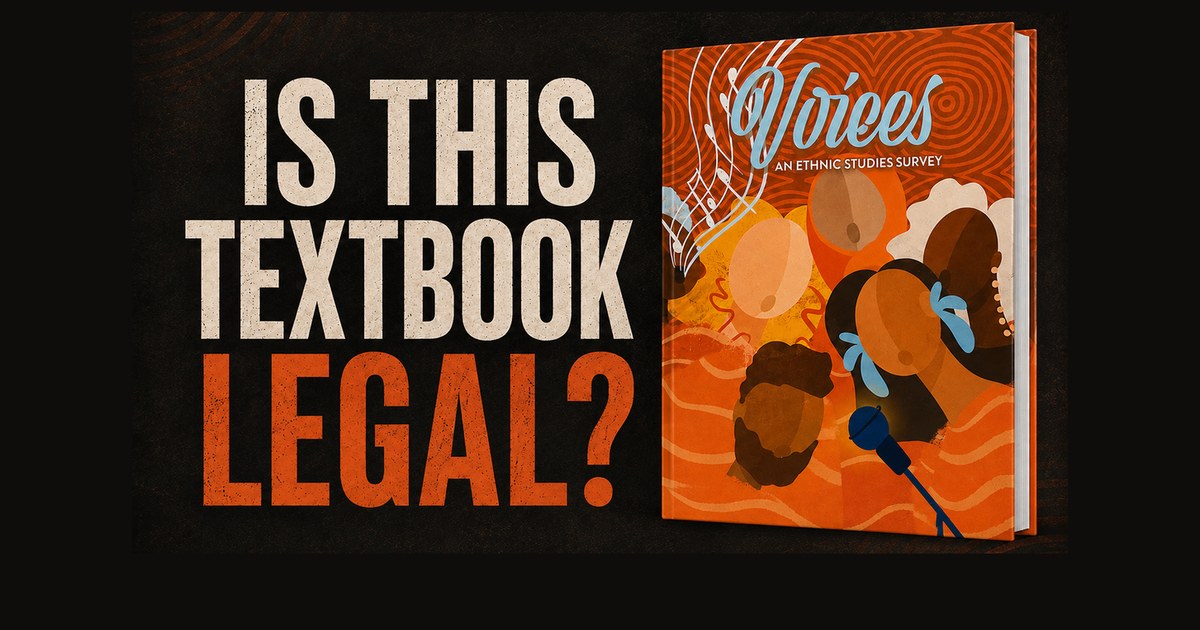
A required course in two Bay Area school districts, bought with public money, teaches students that their race fixes their place in a racial hierarchy. Is that legal? This is not a rhetorical question. It is the lesson at the center of a textbook two Bay Area school districts have made the anchor of a course every student must pass to graduate. In the space of a year, San Francisco Unified and Campbell Union High School District each adopted Voices: An Ethnic Studies Survey , published by Gibbs Smith Education. San Francisco paid roughly $100,000 for it. Campbell, which runs six high schools for some 8,600 students near San Jose, voted 5-0 to commit to the book for six years. Voices is in use elsewhere in California — San Leandro, Inglewood — and in cities around the country. This is a local piece of a much larger rollout. What the book actually teaches There is nothing objectionable about teaching history, which naturally includes the history of racism, slavery, segregation, and exclusion. The objection is what the book teaches children to think about themselves and one another today. Consider how Voices defines its central term. Being White, the book explains, is not only a matter of ancestry; whiteness can also describe “access to power and resources,” and, “in places where White people and their cultures have been dominant,” it can refer to “where one fits in the racial, ethnic, and socioeconomic hierarchy.” Presented this way, race is not a description of a person. It is a measure of where they stand in a hierarchy of power. The book’s “Defining ‘Whiteness’” section describes being White as “access to power and resources” and a matter of “where one fits in the racial, ethnic, and socioeconomic hierarchy.” The book pairs the definition with a widely reproduced graphic, a “wheel of power and privilege” that arranges people by race — along with wealth, gender, body size, and other traits — with those nearest power at the center and those furthest from it on the outer edge, a diagram whose purpose is for a reader to find themselves within it. Between the definition and the wheel, the message to a fourteen-year-old is plain: your race fixes your place on a racial hierarchy, and your task is to find it. Taught as established truth rather than one view among many, that lesson tells a white child and a child of color that they stand at different levels of a racial hierarchy — one higher, one lower — because of the color of their skin. That is not describing history. It is assigning present-tense status by race, to children. The result is strange enough that even the groups the book places nearer the top do not escape it. As the country’s racial hierarchy shifted, the book explains, groups such as Irish, Italian, Asian, and Jewish Americans came to experience “Whitening,” or “being absorbed into the expanding category of being called White.” A people with a long history of persecution is thereby reassigned, by the book’s own logic, to the upper reaches of the hierarchy — filed under the very power and privilege it ranks. Jewish organizations have objected that this erases Jewish identity, and the reality of antisemitism, to fit the model. Voices tells students that Jewish Americans, among others, “experienced ‘Whitening,’ or being absorbed into the expanding category of being called White.” Is teaching this legal? Here it is only fair to separate what is known from what is contested. California law speaks directly to this. The Education Code forbids a school district from sponsoring instruction that “promotes a discriminatory bias on the basis of race.” It forbids the adoption of instructional materials that “reflect adversely upon persons on the basis of race.” And it requires that instruction and materials be “factually accurate . . . rather than advocacy, personal opinion, bias, or partisanship.” In 2026, AB715’s provision that such a violation “does not require a showing of direct harm to members of a protected group” took effect. The argument that Voices crosses these lines is straightforward. A curriculum that places students on a hierarchy of power according to their race, and teaches that placement as fact, promotes a discriminatory bias on the basis of race and presents advocacy as instruction. Because public money pays to teach it, spending that money is — on this argument — unlawful. This post reflects the views of the Jewish Community Advocacy Council on a matter of public concern. It is not legal advice, and the legal questions it discusses have not been decided by any court.
By Mark L. Javitch, Esq. • JCAC Updates (Substack)
August 4, 2026
In 1927, the Supreme Court upheld the conviction of Charlotte Anita Whitney under California’s Criminal Syndicalism Act for helping to organize the Communist Labor Party of California. The Court’s majority opinion, written by Justice Sanford, is largely forgotten. What endures is the concurrence of Justice Louis D. Brandeis — the first Jewish Justice of the United States Supreme Court — joined by Justice Holmes. It is, by wide agreement, the single most important defense of free expression ever written by an American judge. What the Statute Punished California’s 1919 act defined “criminal syndicalism” as any doctrine advocating crime, sabotage, or “unlawful acts of force and violence or unlawful methods of terrorism” as a means of accomplishing industrial or political change. It made it a felony to organize, assist in organizing, or knowingly become a member of any group formed to advocate that doctrine. Brandeis saw immediately what was novel and dangerous in this. The crime was not incitement, not conspiracy, not an attempted act: “The novelty in the prohibition introduced is that the statute aims, not at the practice of criminal syndicalism, nor even directly at the preaching of it, but at association with those who propose to preach it.” The defendant was punished, he wrote, “not for contempt, incitement or conspiracy, but for a step in preparation, which, if it threatens the public order at all, does so only remotely.” Rights Are Fundamental, But Not Absolute Brandeis did not claim speech is beyond regulation. He conceded that free speech and assembly “are not in their nature absolute,” and may be restricted where restriction “is required in order to protect the State from destruction or from serious injury, political, economic or moral.” But the necessity must be real, and the danger must be genuine: “That the necessity which is essential to a valid restriction does not exist unless speech would produce, or is intended to produce, a clear and imminent danger of some substantive evil which the State constitutionally may seek to prevent has been settled.” Crucially, he rejected the idea that a legislature’s say-so settles the question. A statute valid only if certain conditions exist cannot, by its own enactment, prove those conditions. The legislative declaration “creates merely a rebuttable presumption.” Courts retain the power to strike down the law — and that power, he insisted, “is no less when the interests involved are not property rights, but the fundamental personal rights of free speech and assembly.” The Passage That Made It Famous Brandeis then turned from doctrine to first principles, in language closer to civic philosophy than to legal analysis: “Those who won our independence believed that the final end of the State was to make men free to develop their faculties… They believed liberty to be the secret of happiness and courage to be the secret of liberty… that the greatest menace to freedom is an inert people; that public discussion is a political duty.” And his warning about the mechanics of repression, written in 1927, reads as a description of every subsequent century’s failures: “They knew that order cannot be secured merely through fear of punishment for its infraction; that it is hazardous to discourage thought, hope and imagination; that fear breeds repression; that repression breeds hate; that hate menaces stable government; that the path of safety lies in the opportunity to discuss freely supposed grievances and proposed remedies; and that the fitting remedy for evil counsels is good ones.” Then the sentence that changed American law: “If there be time to expose through discussion the falsehood and fallacies, to avert the evil by the processes of education, the remedy to be applied is more speech, not enforced silence. Only an emergency can justify repression.” Fear Is Not a Legal Standard Brandeis was equally clear that public alarm cannot substitute for proof of danger: “Fear of serious injury cannot alone justify suppression of free speech and assembly. Men feared witches and burnt women. It is the function of speech to free men from the bondage of irrational fears.” He drew the distinctions that later courts would adopt wholesale: “The wide difference between advocacy and incitement, between preparation and attempt, between assembling and conspiracy, must be borne in mind.” Even advocacy of law-breaking, “however reprehensible morally,” cannot be punished where it “falls short of incitement and there is nothing to indicate that the advocacy would be immediately acted on.” He added a proportionality requirement as well. Even an imminent danger cannot justify suppression “unless the evil apprehended is relatively serious”; among free men, “the deterrents ordinarily to be applied to prevent crime are education and punishment for violations of the law, not abridgment of the rights of free speech and assembly.” Why He Concurred Anyway Having written the most eloquent defense of speech in the U.S. Reports, Brandeis voted to affirm Whitney’s conviction. The reason was procedural, and he said so plainly. Whitney had argued the statute was unconstitutional as applied, but she had never asked the trial court or jury to decide whether a clear and present danger actually existed, and there was record evidence of a contemporaneous IWW conspiracy to commit present crimes. On a writ of error to a state court, the Justices were confined to “the particular claims duly made below, and denied.” “Because we may not enquire into the errors now alleged, I concur in affirming the judgment of the state court.” It is a lesson in itself: the strongest constitutional argument in the world is worth nothing if it is not properly raised and preserved in the record below. The Afterlife of the Opinion Whitney was expressly overruled in Brandenburg v. Ohio (1969), which adopted, in substance, the Brandeis standard — speech may be punished only where it is directed to inciting imminent lawless action and is likely to produce it. The concurrence has since been quoted in cases on campus speech, protest, boycotts, incitement, and hate speech. Why It Matters Now Brandeis, the first Jewish Justice, arrived at the Court after a bruising confirmation fight shadowed by antisemitism. He understood in his own life what it means to hold unpopular views and belong to a suspect group — and he built his doctrine to protect exactly that person. The protection cuts both ways, which is precisely the point. For Jewish students, faculty, and communal organizations facing hostile campus climates, the Brandeis framework supplies the operative distinctions: advocacy is protected; incitement to imminent lawless action is not. Offensive speech is protected; targeted harassment, threats, and conduct that denies equal access to education are not. The answer to bad argument is better argument — but the answer to intimidation, exclusion, and unlawful conduct is enforcement of the law, which is a different question entirely. Brandeis gave us both halves of that answer in a single opinion. Ninety-nine years later, the task is to apply them accurately.
Whitney v. California, 274 U.S. 357 (1927)
October 27, 2025
A major new demographic study of Sephardic and Mizrahi Jews in the United States challenges one of the most common assumptions in recent Jewish identity discourse: that Jews from Middle Eastern, North African, and Iberian backgrounds identify as “Jews of color” or fit comfortably within diversity, equity, and inclusion (DEI) frameworks. The study, published in August 2025 by JIMENA: Jews Indigenous to the Middle East and North Africa and authored by Dr. Mijal Bitton of NYU , is the most comprehensive examination to date of how Sephardic and Mizrahi Jews understand themselves, their communities, and their place in American Jewish life. It finds that while these Jews represent an estimated 10 percent of American Jewry, most reject being characterized as a racial minority group or as the beneficiaries of DEI initiatives designed for people of color. Read the full study (PDF) Rejecting U.S. Racial Categories The report’s authors interviewed and surveyed Jews with roots in the Middle East, North Africa, Iberia, Central Asia, and Latin America — including Persian, Syrian, Bukharian, and Latin Sephardic communities. Across these diverse groups, the overwhelming finding was that Sephardic and Mizrahi Jews do not see themselves through the racial lens commonly used in American discourse. “The overwhelming majority of our interviewees told us they do not identify with the category of Jews of color.” Participants emphasized family, tradition, and shared history over racial identity. Many found the “Jews of color” label confusing, reductionist, or even alien to their experience. The study notes that conflating Sephardic and Mizrahi identity with U.S. racial categories “risks oversimplifying and mis-capturing lived experience.” Resistance to DEI Framing The study goes further, documenting broad resistance to being framed as a minority population in need of diversity, equity, and inclusion programs. “Most community members … exhibit a notable resistance to language that frames race as their primary identifier, categorizes them as Jews of color, or positions them as a minority group in need of diversity, equity, and inclusion initiatives.” Instead, participants emphasized belonging to a continuous Jewish civilization with deep roots in the Middle East and North Africa — an identity that predates both European modernity and American racial categories. This finding has profound implications for Jewish organizations, universities, and philanthropic foundations that have tried to fold Sephardic and Mizrahi Jews into “Jews of color” programming. According to the report, such efforts often miss the mark because they treat these Jews as marginalized minorities rather than integral participants in the Jewish story. Strong Communal Identity and Deep Jewish Ties Demographically, the study found that Sephardic and Mizrahi Jews report higher rates of synagogue attendance, religious observance, and communal involvement than the national Jewish average. They also report stronger emotional connections to Israel and higher levels of Jewish pride. The study focused on four major communities — Syrian Jews in Brooklyn, Persian Jews in Los Angeles, Bukharian Jews in Queens, and Latin Sephardic Jews in South Florida — each with robust institutions, schools, and philanthropic networks. This communal vitality, the authors note, often contrasts with narratives that portray these Jews primarily as underrepresented minorities. The findings suggest that, while Sephardic and Mizrahi Jews may experience underrepresentation in some mainstream Jewish institutions, they are far from “disempowered.” Implications for Jewish Institutions and DEI Practitioners For Jewish organizations and universities seeking to promote inclusion, the study’s message is clear: listen to how communities define themselves. Treating Sephardic and Mizrahi Jews as a “diversity category” rather than as self-governing communities with their own traditions, leaders, and institutions risks alienating the very people such programs aim to engage. Instead, inclusion efforts should: Prioritize self-definition over imposed labels. Recognize cultural and historical distinctiveness rather than assuming racial minority status. Engage Sephardic and Mizrahi institutions as equal partners — not simply beneficiaries of DEI. Avoid one-size-fits-all frameworks that flatten centuries of Middle Eastern and North African Jewish experience into modern U.S. racial terminology. Rethinking “Diversity” in Jewish Life The JIMENA study ultimately challenges a trend in Jewish communal life that has equated “diversity” with race. For Sephardic and Mizrahi Jews, diversity is about cultural heritage, religious practice, and global continuity — not about fitting into America’s racial typologies. As the authors conclude, meaningful inclusion begins not with labeling but with listening. For institutions that genuinely wish to represent the full breadth of Jewish identity, this study offers both a corrective and a roadmap.

June 2, 2023
J’accuse: US Jewish leadership is failing to defend the community | The Jerusalem Post J’accuse: US Jewish leadership is failing to defend the community - opinion The Jewish establishment left us practically defenseless in the face of this new mutant strain, and that is why – I know it’s a serious charge – we are in this awful situation. OPEN LETTER
By Charles Jacobs • jpost.com

May 23, 2025
From BDS to Hamas, from campuses to Congress, a 20-year timeline of warnings ignored—ending in the murder of two young Israeli embassy workers in the US capital; it is high time to dismantle failed institutions and build a future rooted in strength and preparedness.
By Adam Scott Bellos • ynetnews.com
May 13, 2023
Jews cannot control the forces arrayed against us, but one thing we should be able to do is influence our own leadership. It is clear that the establishment Jewish organizations—the Anti-Defamation League, American Jewish Committee, Conference of Presidents, Federations, Jewish Community Relations Councils, Jewish Public Affairs Council, and most rabbis—have failed to respond effectively to these mounting assaults.
By Charles Jacobs • jns.org
October 6, 2024
The American Jewish Community’s Grand Intelligence Failure Skip to content The American Jewish Community’s Grand Intelligence Failure We American Jews experienced an intelligence meltdown in the wake of the massacre—our failure to predict the eruption of hostility after Oct. 7th. By David Bernstein
By David Bernstein • jewishjournal.com

June 1, 2025
Is America's Jewish leadership failed American Jews? The murder of a young Israeli couple outside the Capital Jewish Museum in Washington, DC, last month traumatized Jews nationwide — leaving many asking tough questions about the state of Jewish leadership in America. Their concern is understandable. While the Hamas attack on Israel two Octobers ago thrust the Jewish nation into its longest war ever, it also ushered in unprecedented levels of antisemitism in the US. There were nearly 10,000 antisemitic incidents nationwide last year, according to the Anti-Defamation League, a 5% increase over the record-breaking numbers in 2023 sparked by the...
By Kathryn Wolf • The New York Post