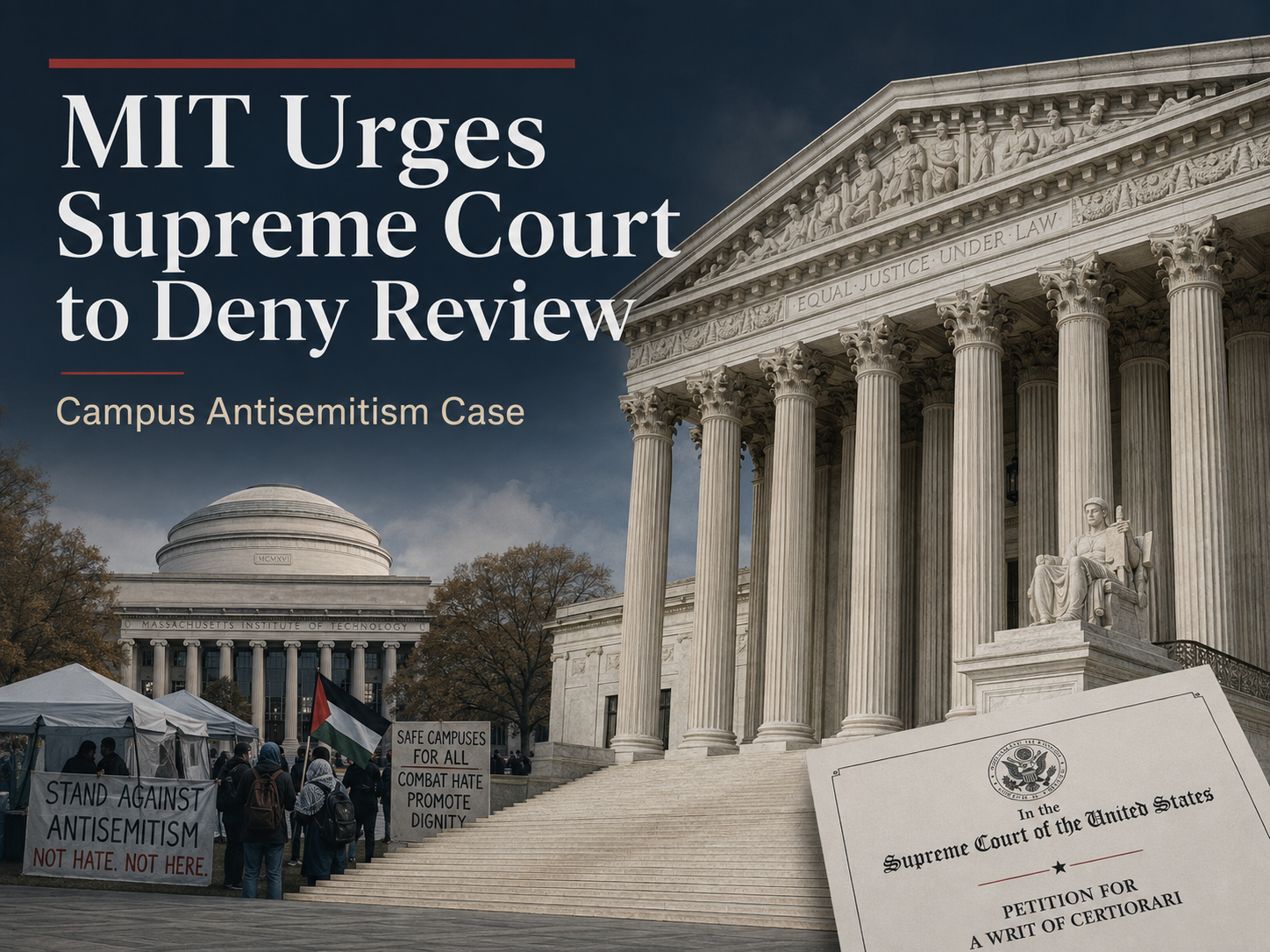
The Massachusetts Institute of Technology has asked the Supreme Court to turn away a closely watched petition arising out of post–October 7 campus protests. In its brief in opposition, MIT argues that the case is a poor vehicle to decide the questions the petitioners are asking, and that the ruling below broke no new legal ground.
The petition, StandWithUs Center for Legal Justice v. Massachusetts Institute of Technology, No. 25-1404, was brought by two MIT students, Katerina Boukin and Marilyn Meyers, along with the StandWithUs Center for Legal Justice. They allege that months of protests, demonstrations, and encampments after the October 7, 2023 attacks created an environment hostile to Jewish and Israeli students, and that MIT was deliberately indifferent to it, in violation of Title VI of the Civil Rights Act of 1964. The district court dismissed the case, the First Circuit affirmed, and MIT now presses three arguments for denial.
The holding the petitioners never challenged
MIT's lead argument is the one it repeats most. When a court gives two separate, self-sufficient reasons for its decision, a challenger has to defeat both to win. Beat one, and the judgment still stands on the other.
That is the trap here. The First Circuit affirmed dismissal on two independent grounds. First, it held that the petitioners had not plausibly alleged an actionable hostile environment. Second, it held that even if they had, MIT was not deliberately indifferent — because, over roughly seven months, the university "took an escalating series of actions aimed at calming the turmoil without violence," including revised expression rules, warnings, interim suspensions, a 24-hour police presence, and, ultimately, arrests.
Both questions in the petition attack only the first ground. Neither touches the second. That, MIT says, is fatal: even if the petitioners won on both questions, the dismissal would still stand on the unchallenged deliberate-indifference holding, and they would gain nothing. A ruling that decides a legal question without changing the result for the parties is an advisory opinion — something the Court does not issue. So there would be no reason to grant review.
The petitioners' only escape is to argue that the two holdings are "intertwined" — that the panel found MIT's response reasonable only because it had already decided little of the conduct counted as harassment. If that were true, overturning the first holding would unsettle the second, and the case would be worth hearing. MIT answers that the panel said the opposite: it called its deliberate-indifference holding "independent" and reached it while assuming the protests were actionable harassment. MIT adds a telling detail — the same district judge, in a separate suit against Harvard, found deliberate indifference adequately pleaded on different facts. That, MIT argues, shows the dismissal here turned on what MIT actually did, not on a stingy view of what harassment is.
No circuit split, and a fact-bound decision
MIT's second argument is that neither question is worth deciding. The first question asks whether a Title VI plaintiff must plead that the harassers acted with discriminatory intent. MIT says the First Circuit announced no such rule. The panel accepted that some conduct was "inherently antisemitic" — crediting incidents that "any thoughtful person would regard as antisemitic," including the heckling of a visibly Jewish student and a tweet equating Jews with Nazis — but found that, taken together, they were not "severe, pervasive, and objectively offensive" enough to be actionable, and that MIT did not know about some of them. The petition does not challenge those fact-specific findings.
MIT also disputes the claimed split among the circuits. The conflicting cases, it says, are employment cases under Title VII, not education cases under Title VI — and the two statutes differ in important ways, including Title VI's requirement of intentional discrimination and its status as a Spending Clause statute that must give funding recipients clear notice of what they are agreeing to. On MIT's reading, the cited cases all apply the same approach the First Circuit used: when conduct is discriminatory on its face, no separate proof of intent is needed; when it is neutral on its face, courts look for some basis to infer it was based on a protected trait.
The First Amendment question — and a reversal of position
The second question asks whether the First Amendment bars a Title VI claim based on protected speech. MIT calls this a "fatal vehicle problem," because the petitioners argued the opposite below.
In the First Circuit, MIT says, the petitioners argued that the protesters' speech fell outside the First Amendment because it was antisemitic — and told the court at argument that they were not asking to compel MIT to suppress otherwise-protected speech. The panel then declined to decide whether racist speech can be punished under Title VI without violating the First Amendment, ruling instead that the allegations fell short in any event. The petitioners, MIT contends, cannot now ask the Supreme Court to decide a constitutional question they gave up below and that the panel never reached.
The free-speech stakes
MIT closes with a warning about how far the petitioners' theory reaches. The case is about Israel and Palestine, but the rule the petitioners seek is not. If a university could be liable for failing to censor speech that another student experiences as discriminatory — even ordinary political speech, and even when the speaker meant only to voice an opinion — then administrators would be pushed to police campus debate on affirmative action, immigration, transgender rights, and much else. Calling the classroom the "marketplace of ideas," MIT casts its position as a defense of open debate rather than an excuse for inaction.
What comes next
The brief is careful to affirm MIT's opposition to antisemitism, quoting the university's president: "Antisemitism is real, and it is rising in the world. We cannot let it poison our community." The question for the Court is not whether antisemitism occurred at MIT, but whether this complaint, on these facts, states a Title VI claim — and whether the case's posture lets the Court say anything broader.
Eight amicus briefs were filed in support of the petitioners: the American Center for Law and Justice; the Manhattan Institute; the Center for Jewish Legal Studies; U.S. Senators Ted Cruz and Rick Scott with the National Jewish Advocacy Center; the Louis D. Brandeis Center for Human Rights Under Law with the American Jewish Committee; the Institute for the Study of Global Antisemitism and Policy; Professor David E. Bernstein; and Hillel: The Foundation for Jewish Campus Life with the Anti-Defamation League. The petition has been distributed for the Court's conference of September 28, 2026.