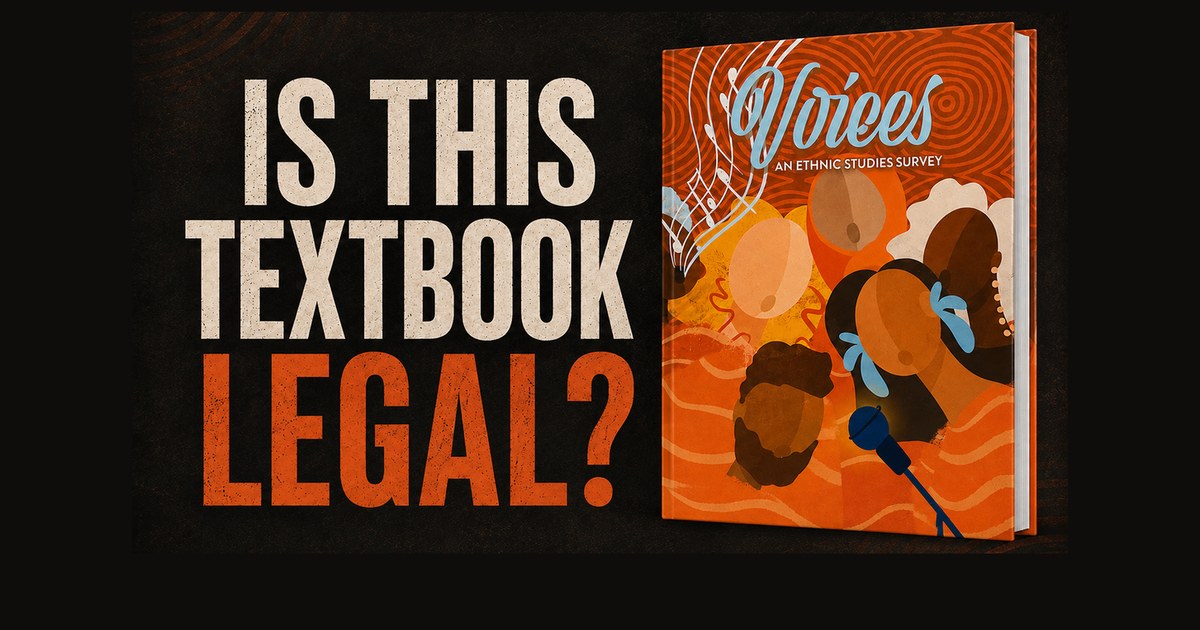
A required course in two Bay Area school districts, bought with public money, teaches students that their race fixes their place in a racial hierarchy. Is that legal?
This is not a rhetorical question. It is the lesson at the center of a textbook two Bay Area school districts have made the anchor of a course every student must pass to graduate.
In the space of a year, San Francisco Unified and Campbell Union High School District each adopted Voices: An Ethnic Studies Survey, published by Gibbs Smith Education. San Francisco paid roughly $100,000 for it. Campbell, which runs six high schools for some 8,600 students near San Jose, voted 5-0 to commit to the book for six years. Voices is in use elsewhere in California — San Leandro, Inglewood — and in cities around the country. This is a local piece of a much larger rollout.
What the book actually teaches
There is nothing objectionable about teaching history, which naturally includes the history of racism, slavery, segregation, and exclusion. The objection is what the book teaches children to think about themselves and one another today.
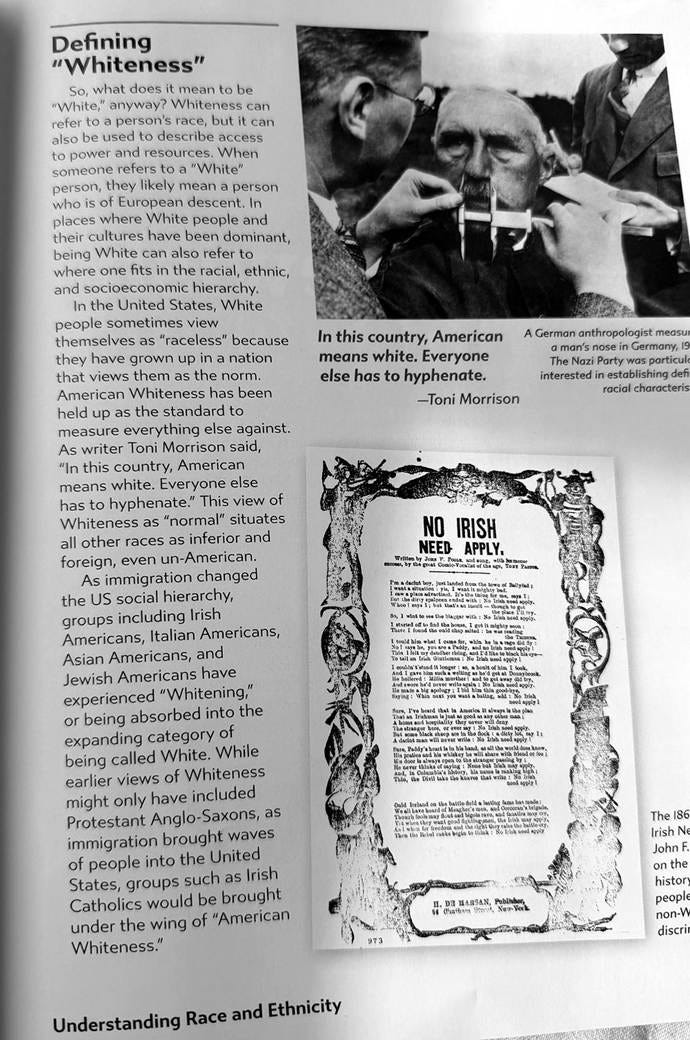
Consider how Voices defines its central term. Being White, the book explains, is not only a matter of ancestry; whiteness can also describe “access to power and resources,” and, “in places where White people and their cultures have been dominant,” it can refer to “where one fits in the racial, ethnic, and socioeconomic hierarchy.” Presented this way, race is not a description of a person. It is a measure of where they stand in a hierarchy of power.
The book pairs the definition with a widely reproduced graphic, a “wheel of power and privilege” that arranges people by race — along with wealth, gender, body size, and other traits — with those nearest power at the center and those furthest from it on the outer edge, a diagram whose purpose is for a reader to find themselves within it. Between the definition and the wheel, the message to a fourteen-year-old is plain: your race fixes your place on a racial hierarchy, and your task is to find it.
Taught as established truth rather than one view among many, that lesson tells a white child and a child of color that they stand at different levels of a racial hierarchy — one higher, one lower — because of the color of their skin. That is not describing history. It is assigning present-tense status by race, to children.
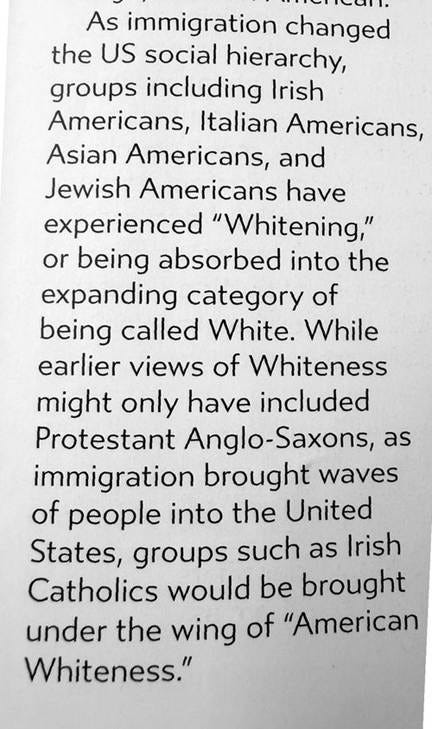
The result is strange enough that even the groups the book places nearer the top do not escape it. As the country’s racial hierarchy shifted, the book explains, groups such as Irish, Italian, Asian, and Jewish Americans came to experience “Whitening,” or “being absorbed into the expanding category of being called White.” A people with a long history of persecution is thereby reassigned, by the book’s own logic, to the upper reaches of the hierarchy — filed under the very power and privilege it ranks. Jewish organizations have objected that this erases Jewish identity, and the reality of antisemitism, to fit the model.
Is teaching this legal?
Here it is only fair to separate what is known from what is contested.
California law speaks directly to this. The Education Code forbids a school district from sponsoring instruction that “promotes a discriminatory bias on the basis of race.” It forbids the adoption of instructional materials that “reflect adversely upon persons on the basis of race.” And it requires that instruction and materials be “factually accurate . . . rather than advocacy, personal opinion, bias, or partisanship.” In 2026, AB715’s provision that such a violation “does not require a showing of direct harm to members of a protected group” took effect.
The argument that Voices crosses these lines is straightforward. A curriculum that places students on a hierarchy of power according to their race, and teaches that placement as fact, promotes a discriminatory bias on the basis of race and presents advocacy as instruction. Because public money pays to teach it, spending that money is — on this argument — unlawful.
This post reflects the views of the Jewish Community Advocacy Council on a matter of public concern. It is not legal advice, and the legal questions it discusses have not been decided by any court.